
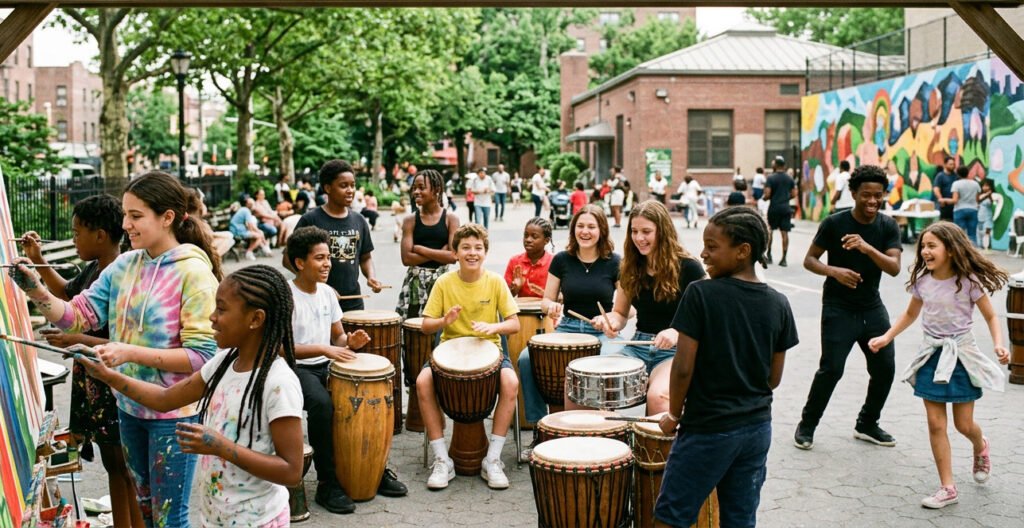
The AreitoTaino Group is deeply committed to addressing the growing crisis facing today’s youth—the diminishing access to arts education as a vital part of their personal and cultural development. For many young people, especially those from marginalized and underrepresented communities, the arts are not merely extracurricular; they are essential pathways to self-expression, confidence, and belonging. In Queens, one of the most diverse communities in the world, AreitoTaino works to ensure that every child has the opportunity to explore their creative potential and connect with their cultural heritage through inclusive, community-driven arts programs. By preserving Indigenous and Afro-Caribbean traditions while fostering new artistic voices, AreitoTaino safeguards the next generation’s potential and well-being through the transformative power of the arts.
As stated by Soraya Sussman, Co-founder & CEO of The AreitoTaino Group, “We as individuals and as a collective society have become accustomed to investing in quick rewards and instant satisfaction, rather than cultivating and safeguarding our most valuable asset—our children. They are the next generation who will ensure that our nation and our world thrive and prosper for all. The arts are the key to our collective humanity.”
As highlighted in Nickolas Bagley’s March 12, 2025, article for The Wallace Foundation, University of Pittsburgh, forum for youth Investment, well-being, and Well-becoming Through the Arts: A Picture of Mattering for Youth of Color, it is essential to preserve and strengthen “culture-centered, community-based youth arts programs.” These programs not only nurture creativity but also affirm identity, belonging, and purpose among youth of color.
Summary of The Wallace Foundation Article
As fewer and fewer schools offer arts learning opportunities, out-of-school time organizations in many communities have stepped in to fill that space. This is particularly true in neighborhoods with low income and diverse populations, where robust arts programs are least likely to be present in schools.
A team of researchers at the University of Pittsburgh set out to explore the values and goals that these community-based arts organizations brought to the design of their programs. Through their work, they have defined them as “culture-centered, community-based youth arts programs.” They have identified seven program design characteristics and a range of reported positive youth outcomes.
Read the full article from The Wallace Foundation website
Soraya continues, “In addition, an article by the National Endowment for the Arts—Educating Ourselves about Childhood Arts Experiences—and Why They Matter (Feb 11, 2025, by Sunil Iyengar), performing a longitudinal study following children for a long period of time, reinforced the need to step up and provide art-related activities and interactions at an early age. The study highlights the importance of introducing art and art-related experiences during the very early childhood developmental stages, as well as the value of out-of-school art activities, which show a positive correlation with many social-emotional attributes and academic achievements.”
“By following these groups of children through time, the researchers derive conclusions not only about the availability of arts experiences to children in and out of school, but also their participation in arts learning, and how these experiences support healthy development and academic progress.”
Read the full article on the National Endowment for the Arts website
Source
Bagley, Nickolas, Well-being and well-becoming through the arts: A picture of mattering for youth of color. Posted on March 12, 2025; The National Endowment for the Arts
Wallace Foundation | University of Pittsburgh | Forum for Youth Investment
Iyengar, Sunil, Educating Ourselves about Childhood Arts Experiences—and Why They Matter (Feb 11, 2025)