
Introduction
Art is often treated as a luxury—something beautiful but optional. We hang paintings on walls, attend plays when we have time, and take children to museums on weekends if we can afford it. But what if art is not a luxury at all? What if it is as essential to human health and flourishing as exercise, sleep, and social connection?
A growing body of scientific research suggests exactly that. From reducing stress hormones to rewiring our brains for empathy, art in all its forms—visual art, theater, dance, music, and literature—profoundly shapes who we are and how we navigate the world.
This two-part series explores what the latest studies reveal about art’s measurable impact on our minds, bodies, and communities. In Part 1, we examine how art physically changes our brains and heals our bodies.
Part 1: Art Changes Our Brains—Literally
For decades, we have intuitively known that art feels good. Now neuroscience is showing us why—and how deeply art reshapes our neural architecture.
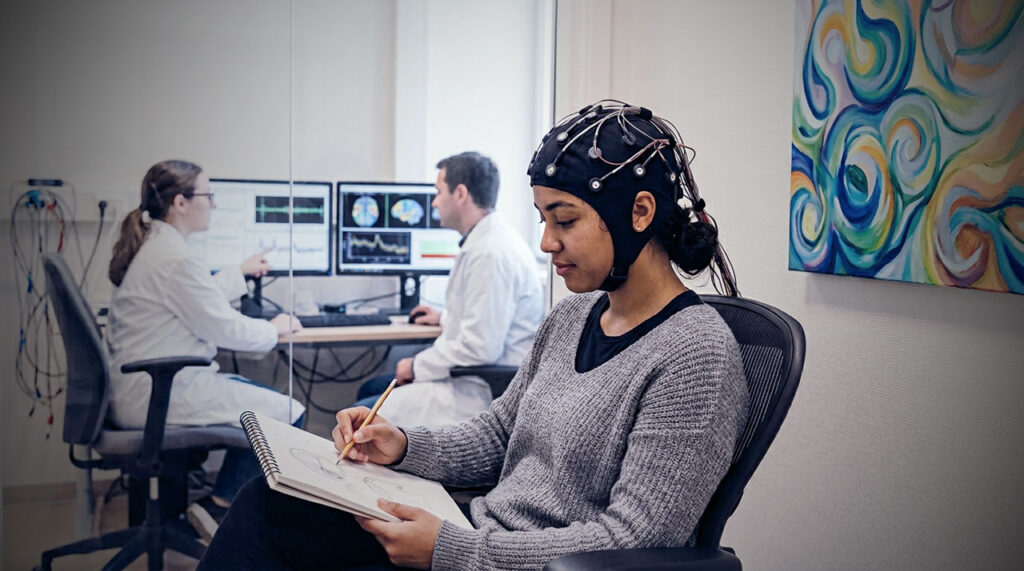
A 2025 study published in npj Science of Learning, a Nature journal, examined how long-term engagement in visual arts education relates to brain function and creativity. Researchers compared design majors to non-design majors using functional near-infrared spectroscopy (fNIRS) to monitor brain activity during creative tasks. The results were striking: design majors outperformed their peers across creativity tasks and showed greater activation in the left dorsolateral prefrontal cortex—a region associated with cognitive control and idea generation—during early creative phases. Meanwhile, non-design peers relied more on sensory and motor regions. The design group also demonstrated greater neural efficiency, showing reduced coupling within task-relevant circuits, meaning their brains worked more efficiently rather than harder.
Link to study: Neural mechanisms underpinning the association between visual arts education and creativity
This matters far beyond the art classroom. Efficient, flexible brain networks are associated with better problem-solving, adaptability, and even resilience in the face of stress. Arts education doesn’t just teach skills—it may fundamentally optimize how our brains operate.
Part 2: Art Heals—Reducing Stress and Boosting Well-Being
Perhaps the most immediately relevant finding for our daily lives is art’s remarkable ability to reduce stress and improve mental health.
A first-of-its-kind study co-funded by the Psychiatry Research Trust and Art Fund, conducted by researchers at King’s College London, measured physiological responses while participants viewed masterpieces in a gallery setting. The research found that viewing art activates the immune, endocrine (hormone), and autonomic (cardiovascular) systems all at once—a response previously unrecorded in scientific literature. Cortisol levels, a key stress hormone, fell by an average of 22% in the gallery group, compared to just 8% for those viewing reproductions in a laboratory. Those viewing original art also had more dynamic heart activity, indicating that art engages the body through both emotional arousal and stress regulation.
Link to study: New Research Co-Funded by The Psychiatry Research Trust reveals Positive Impacts of Art on the Body
A systematic review and meta-analysis published in 2025 examined the effects of dance and theater-based interventions on life satisfaction. Analyzing 12 articles with 8 included in the meta-analysis, researchers found that dance and drama interventions significantly improved life satisfaction across participants of different ages and conditions (p = 0.01). The authors concluded that these art forms are “useful to enhance the life satisfaction of people” through therapeutic factors unique to art therapies: embodiment (connecting with the body), concretization (transforming abstract content into tangible form), and symbolism/metaphors (projecting internal material into expressive forms).
Link to study: Effects of art therapy interventions on satisfaction with life: A systematic review and meta-analysis
Conclusion to Part 1
The evidence is already compelling: art physically reshapes our brains for greater efficiency and creativity, and it measurably reduces stress while improving life satisfaction. But the story does not end here. In Part 2, we will explore how art builds meaning and purpose, strengthens empathy and social connection, enhances critical thinking, and why these findings demand that we rethink art as a public health resource.
Continue to Part 2 →